
15 Dec National Active School Streets Initiative: What We Have Accomplished So Far
By Jiya Benni, Director of Programs and Development
Back in June 2024, we announced the launch of the National Active School Streets Initiative (NASSI), a nationwide collaboration between 8 80 Cities, Green Communities Canada (GCC), Centre d’écologie urbaine, Université de Montréal, University of British Columbia, Queen’s University, and Toronto Metropolitan University and 16 local partner organizations (LPOs) spanning six provinces (British Columbia, Alberta, Manitoba, Ontario, Quebec, and New Brunswick) to implement and study School Streets in different communities. The Public Health Agency of Canada funds the program. The School Streets program soon expanded in BC with funding from the Government of British Columbia.
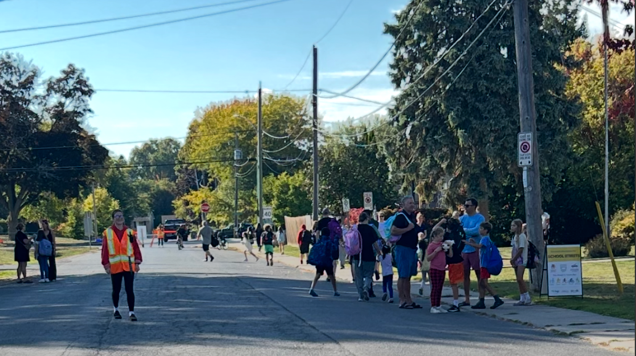
Our Lady of Lourdes Catholic School School Street, Kingston, ON, Credit: Kylie Filion, BGC Southeast Kingston
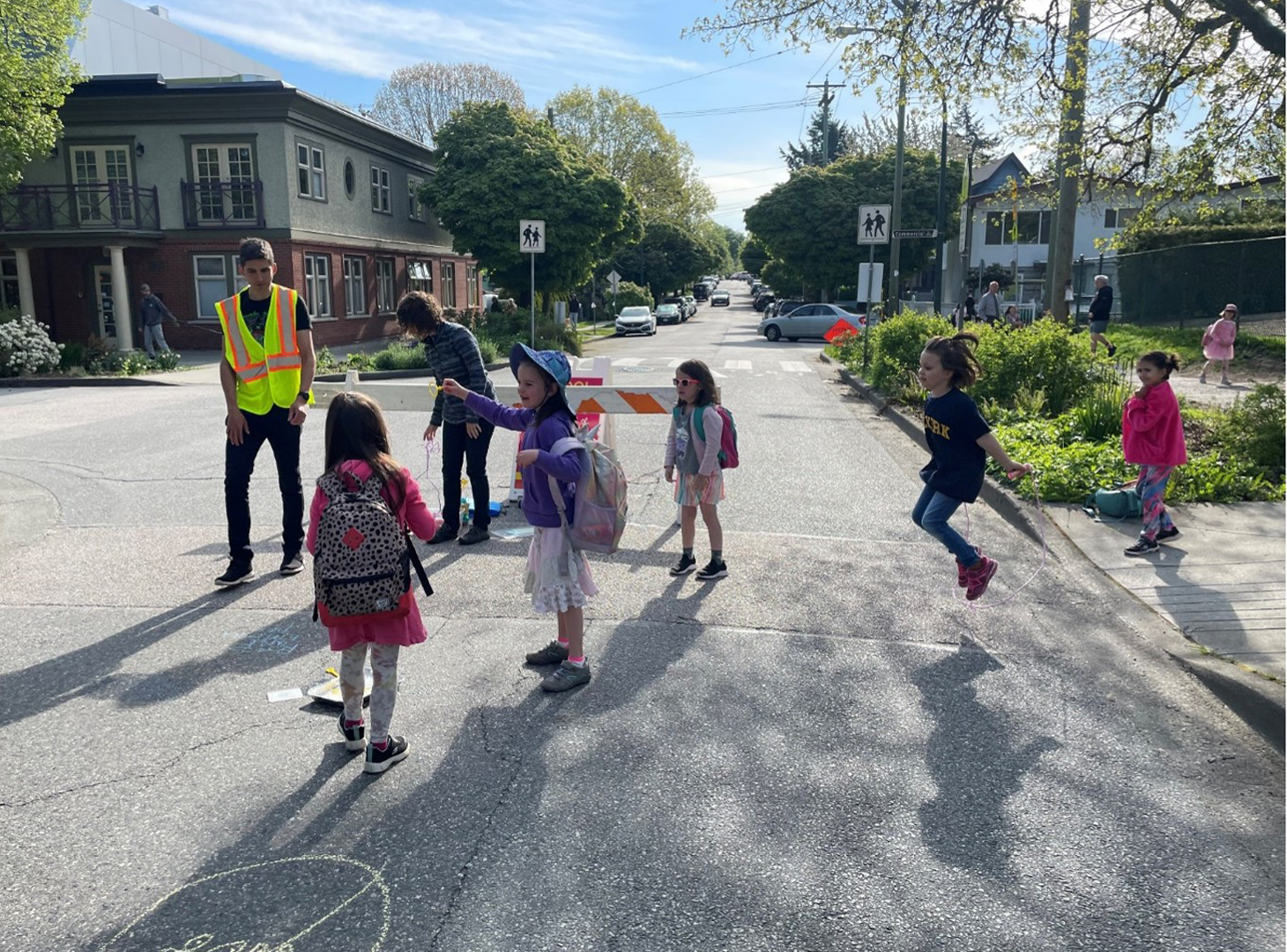
For those who do not know, School Streets are programs that create a car-free environment in front of schools at the start and end of the school day to prioritize safe walking conditions for children, their caregivers and teachers. It offers many benefits, including increasing active travel, reducing air pollution, improving road safety, supporting children’s mobility, and fostering social connection. You can read more about how 8 80 Cities has contributed to this movement to advance School Streets in Canada here.
Through NASSI, local partner organizations will implement School Streets at varying scales, ranging from a week to a whole year. The research partners study the impact of School Streets on communities, particularly underrepresented groups such as low-income, racialized, and newcomer populations.
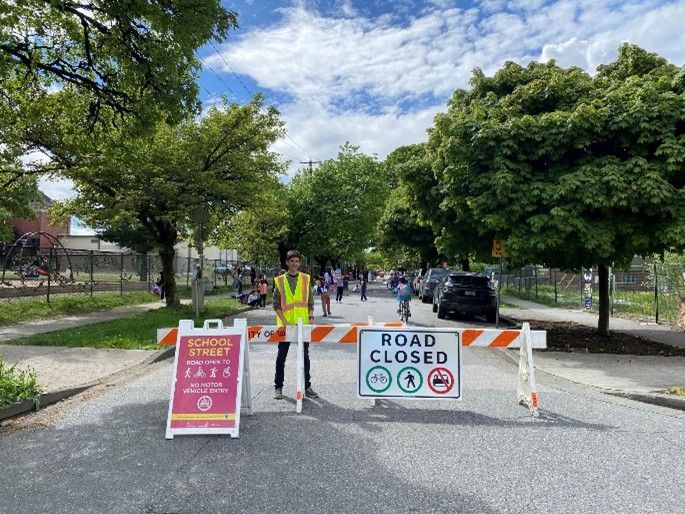
Lord Selkirk School Street, Vancouver BC, Credit: City of Vancouver
8 80 Cities, Centre d’écologie urbaine (CEU) and Society for Children and Youth of BC (SCY) serve as the technical leads for the initiative. Together, we co-facilitate a Community of Practice (COP) for all the LPOs. The Community of Practice kicked off in September 2024 and has taken place every other month since then (except for a month’s break this summer.) The Community of Practice is a space to share their experience planning, implementing, and evaluating School Streets, to be inspired by hearing about School Streets around the world, and to network with practitioners.
The LPOs also go through a Training Program developed and delivered by 8 80 Cities, Centre d’écologie urbaine (CEU), and Society for Children and Youth of BC (SCY). This is delivered in two rounds to small groups of LPOs. The Training Program covers topics such as site selection, stakeholder mapping, communications, community engagement, design and management of School Streets, to name a few. To date, 8 80 Cities has trained 6 LPOs and is currently delivering the second round of the Training Program alongside CEU. While the COP is a space for LPOs to exchange ideas and troubleshoot solutions to implement and advance School Streets in their communities, the Training Program provides them with the tools to plan and implement School Streets. As one of the technical leads, we also provide individual support to the LPOs.
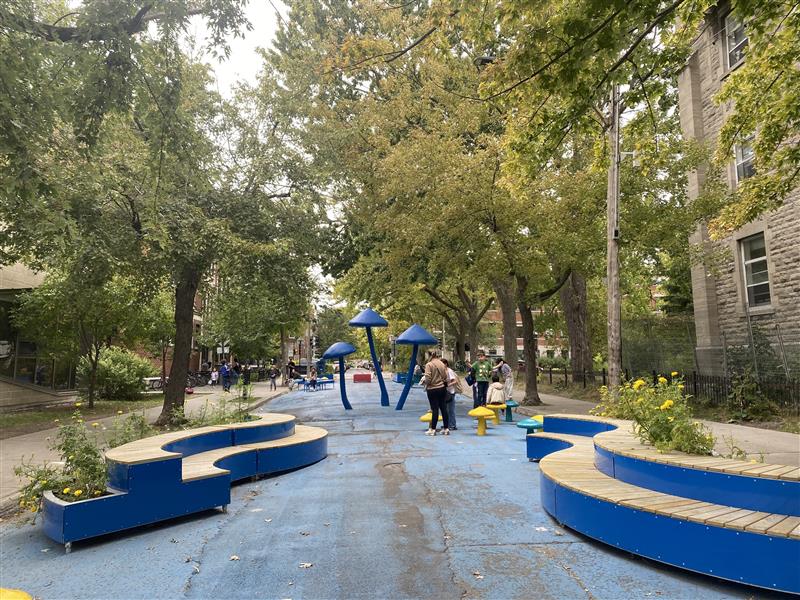
La Place De L’Ange-Cornu, Permanent School Street in Montreal
The implementation of School Streets began in the Fall of 2024, when the Plateau Mont-Royal borough in Montreal, QC, converted La Place De L’Ange-Cornu into a permanent School Street. In the Fall of 2025, three-year School Streets were launched in Mississauga (on pause until further notice), Kingston, and Vancouver. School Street implementations are not without challenges, but the teams are troubleshooting and finding solutions as they go. Others plan to implement their School Street programs in Spring and Fall 2026 and Spring 2027.
2025 has been an excellent year for the initiative, with five Community of Practice sessions hosted, six Training Program sessions delivered, and three School Street programs implemented. The core team gathered in Montreal in September to reflect, strategize, and reaffirm our project goals.
In 2026, we are looking forward to seeing a few more School Streets implemented. We will be working with our incredible partners to continue co-facilitating the Community of Practice, to wrap up the Training Program, and to publish a Practitioners Toolkit.
For many years, we designed our communities in a way that puts children in neat little boxes in playgrounds. By prioritizing vehicles and deprioritizing children’s safety, we have removed children from our streets – and streets are one of our largest public spaces. Children do not get to move freely through our streets. This means they are not full participants in our cities. When they can walk and bike freely in our communities, they learn more about them and develop the ability to assess risk and move independently. This also brings a sense of pride and autonomy for them. As practitioners, we have the unique power to make this possible for them. With programs like School Streets, we are opening our cities to children; we are inviting them to take up space and turn them into joyful places.
If you are interested in starting a School Street program in your community, contact us.