
30 Jul What July Taught Us About Cities, FIFA, and Who We Plan For
By Hannah Huen, 8 80 Cities Summer Communications Volunteer, and Camila Uriona, 8 80 Cities Manager of Communications
As July comes to a close, Toronto is slowly getting back into its usual rhythm. The crowds on the streets are settling down, and jerseys are being tucked away. For a few weeks, the city became a gathering place for people from around the world to attend the long-awaited FIFA World Cup.
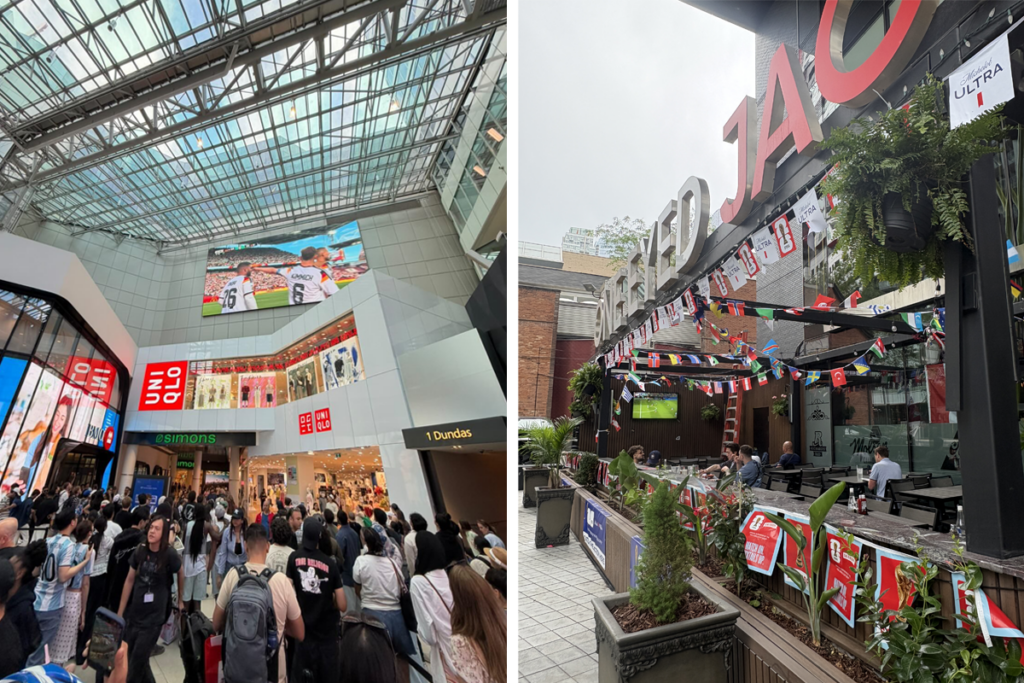
Left: Fans at Eaton Centre watching a game. Photo by: Ryan Lok. Right: Fans at a bar in Richmond Hill. Photo by: Hannah Huen
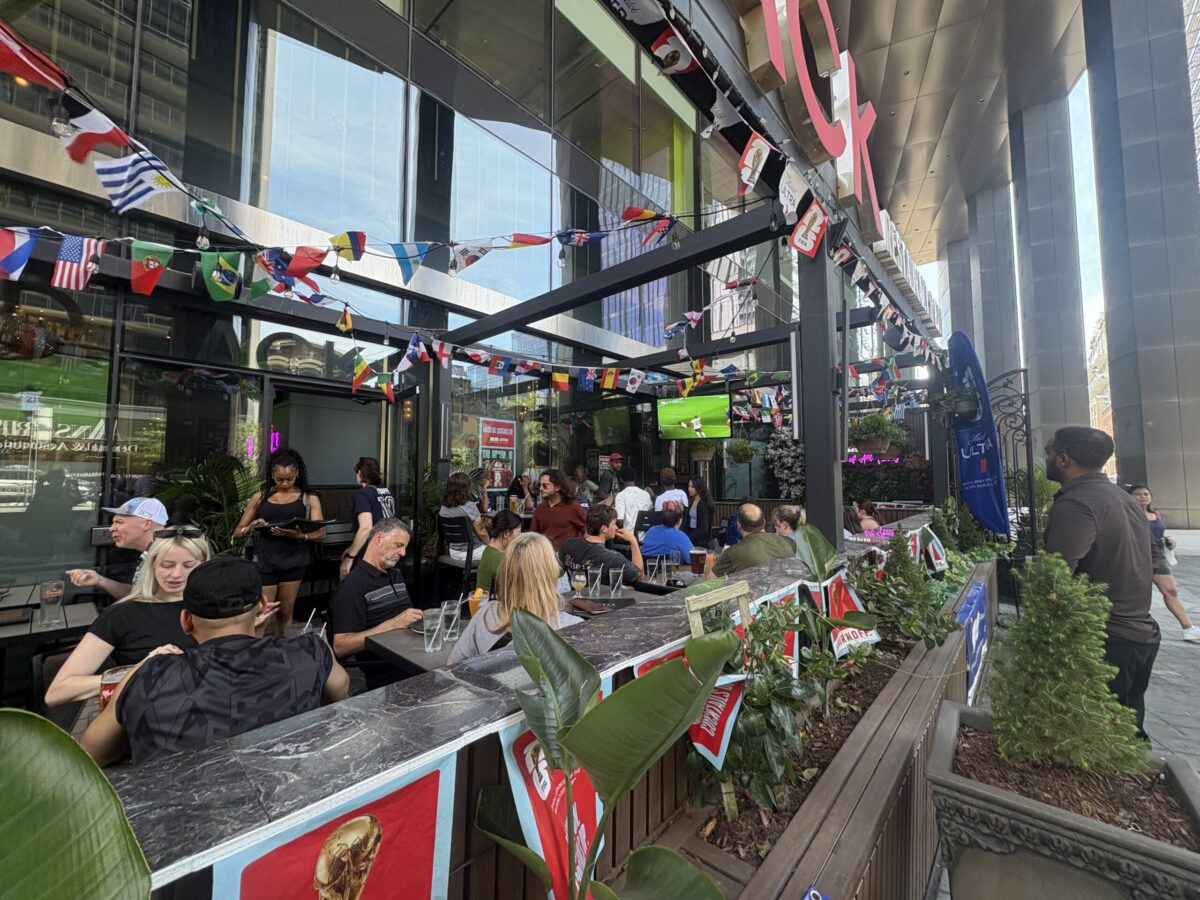
From watch parties at home, in bars, and even in subway stations, to the streets as fans walked together to the stadium to cheer for their countries’ teams, it is undeniable that the tournament brought a sense of excitement and community that we don’t often come across. Soccer, or football (depending on where you’re from), became a universal love language that crossed citizenships and generations.
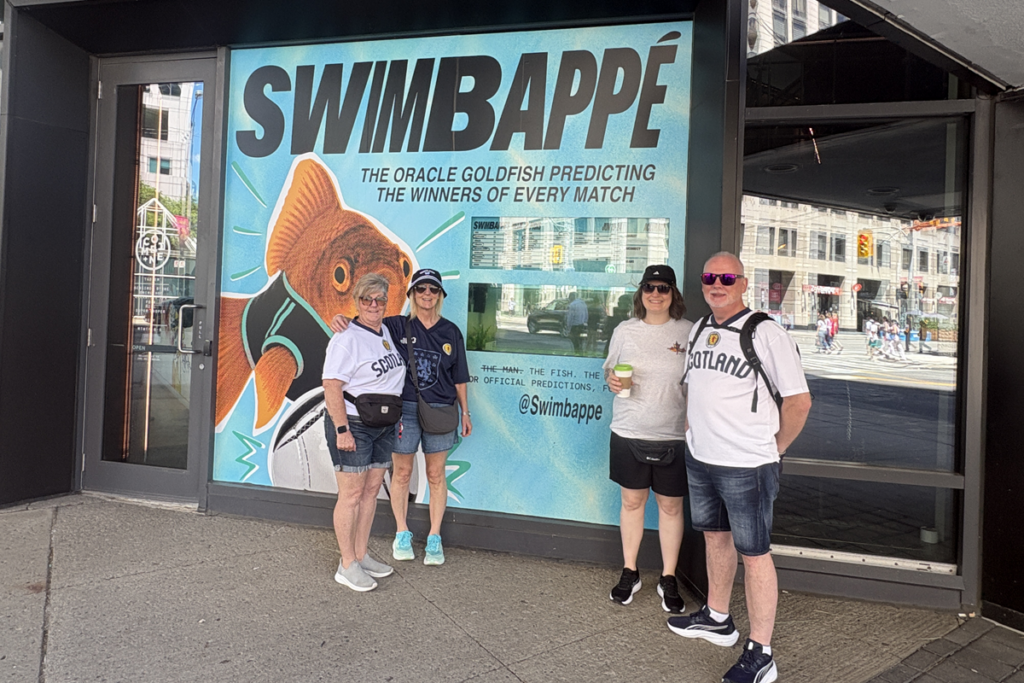
Scottish fans hoping to match Swimbappé the Goldfish, predictions. Photo by: Camila Uriona.
Toronto is often widely recognized as one of the most diverse cities in the world, but what and who makes a city diverse? Is it the Chinatown along Spadina? The Village on Church Street? What about the hundreds and thousands of people who take the TTC every day? While these are all valid responses, one question remains. How is Toronto addressing and tending to the needs of vulnerable populations, specifically those experiencing homelessness who were largely affected and displaced during the World Cup?
Diversity isn’t just about who lives or moves through the city, but rather, whether or not everyone has the opportunity to feel like they belong. While the World Cup gave Toronto an opportunity to showcase its diversity to the world, it also invited us to reflect more upon who gets to experience the city in moments of celebration, and who gets pushed aside.
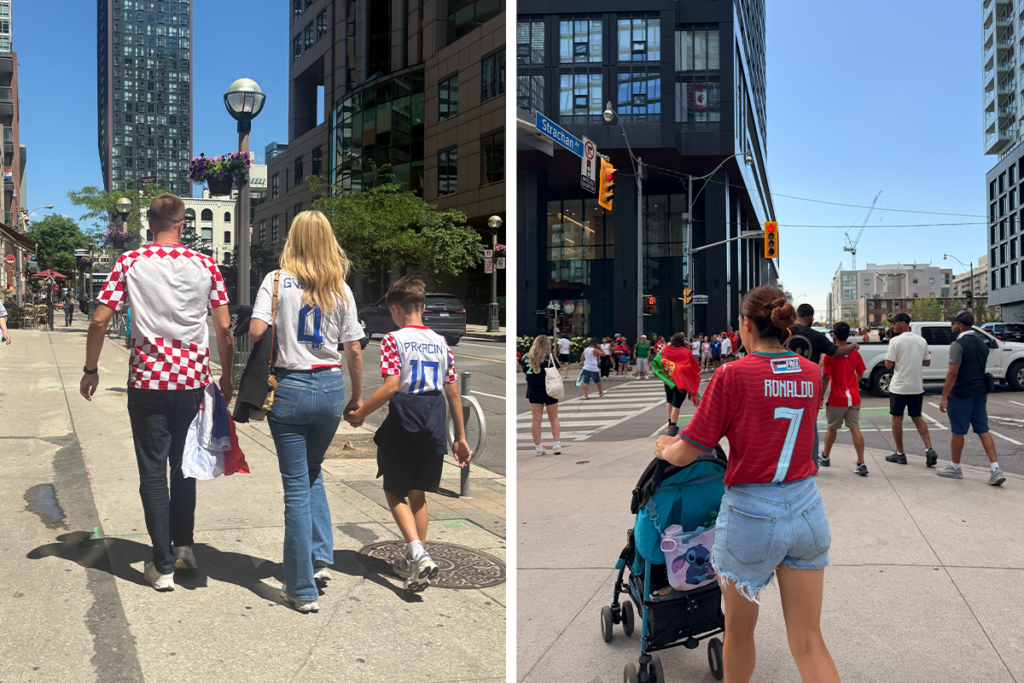
Left: A Croatian family walking downtown Toronto on a game day. Photo by: Hanna Hue. Right: A woman wears a Portugal jersey walking to the stadium with her baby in a stroller. Photo by: Jiya Benni.
To learn more, we chatted with David Roberts, professor of urban studies at the University of Toronto and research co-director of a research team assessing Human Rights and FIFA 2026, to discuss how the games affected the way we use public spaces, which individuals are neglected in the process, and what cities can do to ensure that future events like this promote a more inclusive and accessible space for everyone.
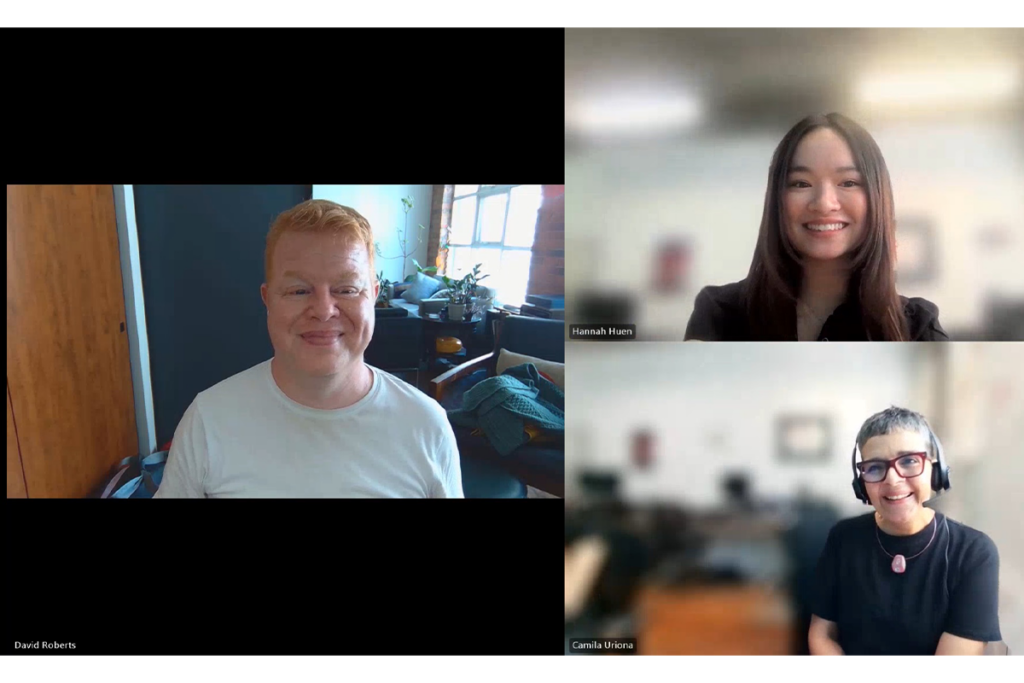
David Roberts (left); Hanna Huen (upper right); and Camila Uriona (bottom right)
8 80 Cities (8 80): How do big events like the FIFA World Cup change the way public spaces are used, and who ultimately gains, or loses access to those spaces?
David Roberts (DR): In 2010, South African cities passed a bunch of requirements that could loosely be described as nuisance laws. Essentially, they targeted people who seemed to be a nuisance in public spaces. However, these were vague descriptions of what that specifically might be: lying down, sitting, playing loud music, whatever it might be. These empowered the police to determine who was a ‘nuisance’ and to displace them from public space. Those types of things have become more common, where you see the presence of police targeting people who are out of place. TUHU (Toronto Unhoused and Homeless Union) has made the argument that a big chunk of the people being displaced in Toronto are individuals experiencing homelessness. Teenagers and young people are also often the targets of these nuisance laws, seen as disruptive, making tourists nervous, or whatever it might be.
One good example of this that we don’t talk about enough is protesters. If you are angry about any aspect of anything, usually in Canada, we have the right to protest. You certainly do not have the right to protest anything at FIFA Fan Fest or near the stadium.
8 80: When we talk about public spaces, are there any lasting impacts or investments in terms of the before and after of hosting FIFA games?
DR: The biggest one is that police budgets don’t usually go down – they go up. So we’ll have a ballooning of police budgets, and new practices and approaches that sometimes keep being used when the World Cup is done. I think we should be monitoring the ongoing effects of policing in public spaces and transit. What I’ll advise TUHU is to keep monitoring what is happening at Union Station because what we saw before and during the World Cup might have been a normalization of policing in public space and targeting of homeless people. Another thing that the World Cup normalizes is the use of public funds for private gain.
8 80: In your research, have there been any examples of host cities who have taken measures to address this issue, and if so, what can we learn from them?
David: No, it is nearly impossible for a city to get it right. It’s expensive to host (an estimate of 380 million in Toronto); most cities don’t provide themselves with enough of a runway to do the types of interventions and investments that would have positive change; instead, they do the start work far too late and are rushed. Also, the criteria for success are often defined by an external group (FIFA, tourists, international media). And the focus is on aesthetics over big change. What gets exposed is the contrast between a liveable city and a tourist-friendly city.
8 80: From an ‘8 80’ perspective, what would a successful way to host the FIFA games look like – one that makes Toronto more inclusive and accessible, for everyone, not just for visitors?
DR: One, privatization. I would have a fundamentally different feeling of the World Cup if, as a country, we didn’t spend over a billion dollars of taxpayer funding on this event. An event which is completely inaccessible for the majority of people. Number two, I think that we as a city and country need to better think about how we leverage public funds. If we’re going to pay all this money from public funds for a private event, we have to think about what that then does to improve equity issues. If we’re going to do this, we have to think about how we leverage it for social benefits and long-term legacies. Three, it goes back to a human rights commitment. We need to put together a more robust commitment to human rights, one that is designed in conversation with individuals who have lived experience with various vulnerabilities. Otherwise, we would have a private event with public funding that exacerbates already existing inequalities, and that’s just untenable.
Our conversation with David Roberts reminded us that the true impact of mega-events isn’t measured only by tourism or the excitement it generates, but rather, it is the decisions cities make in preparation for these events, where money is invested, and how they choose to welcome people into public spaces.
At 8 80 Cities, we believe that great cities are designed for everyone from an 8-year-old to an 80-year-old. But the 8 80 framework extends beyond mere age. It’s a reminder that cities should welcome people of all backgrounds, abilities, and circumstances all year long, with or without big celebrations like the World Cup. One of the biggest learnings from Toronto hosting the FIFA games this July is that a city’s success shouldn’t be judged by how well it welcomes visitors for a few weeks, but by how well it serves its community and how it actively advocates, cares, and celebrates diversity.
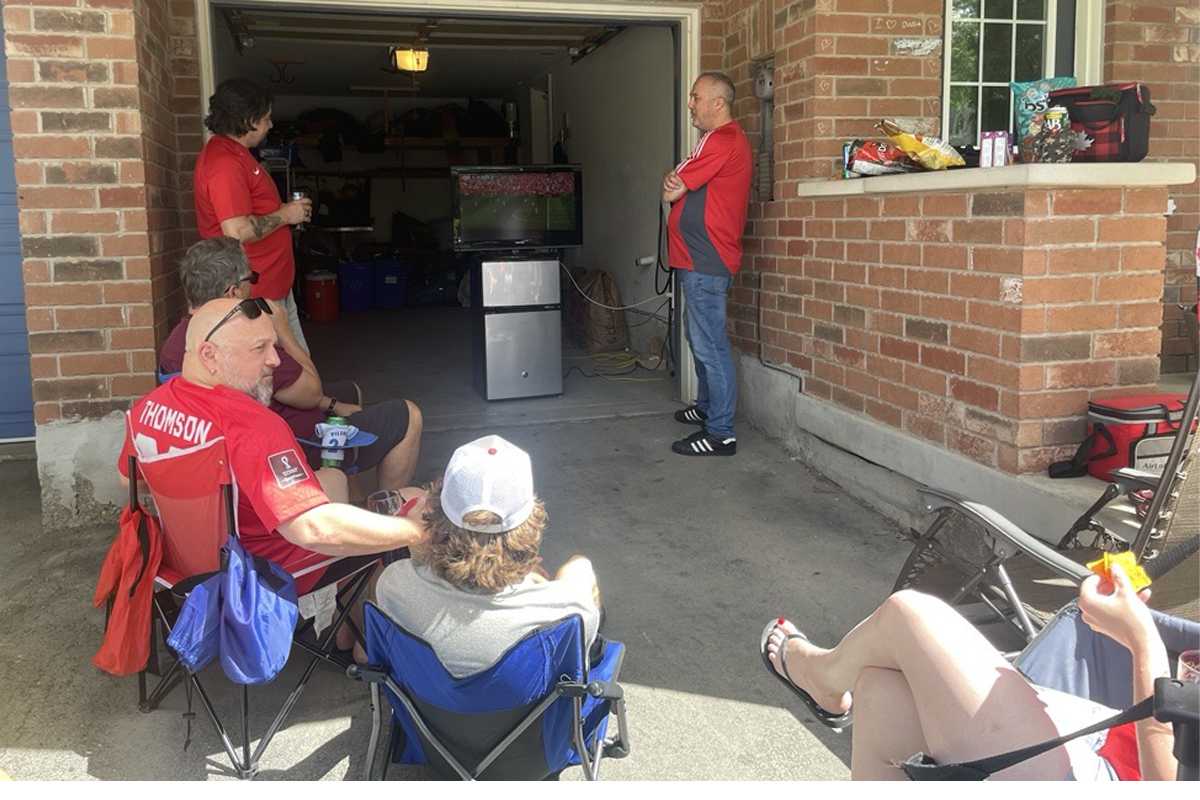
Neighbours in Milton, ON, improvise a garage watch party on the inaugural Canada – Bosnia Herzegovina game. Photo by: Camila Uriona.
Learn more about David Roberts here.
Learn more about Hannah Huen and Camila Uriona here.